The rustle of the wind in the pines

For twenty years, the Japanese ritual of drinking tea has been practised at the Museum Rietberg, a visit to the wintry park.

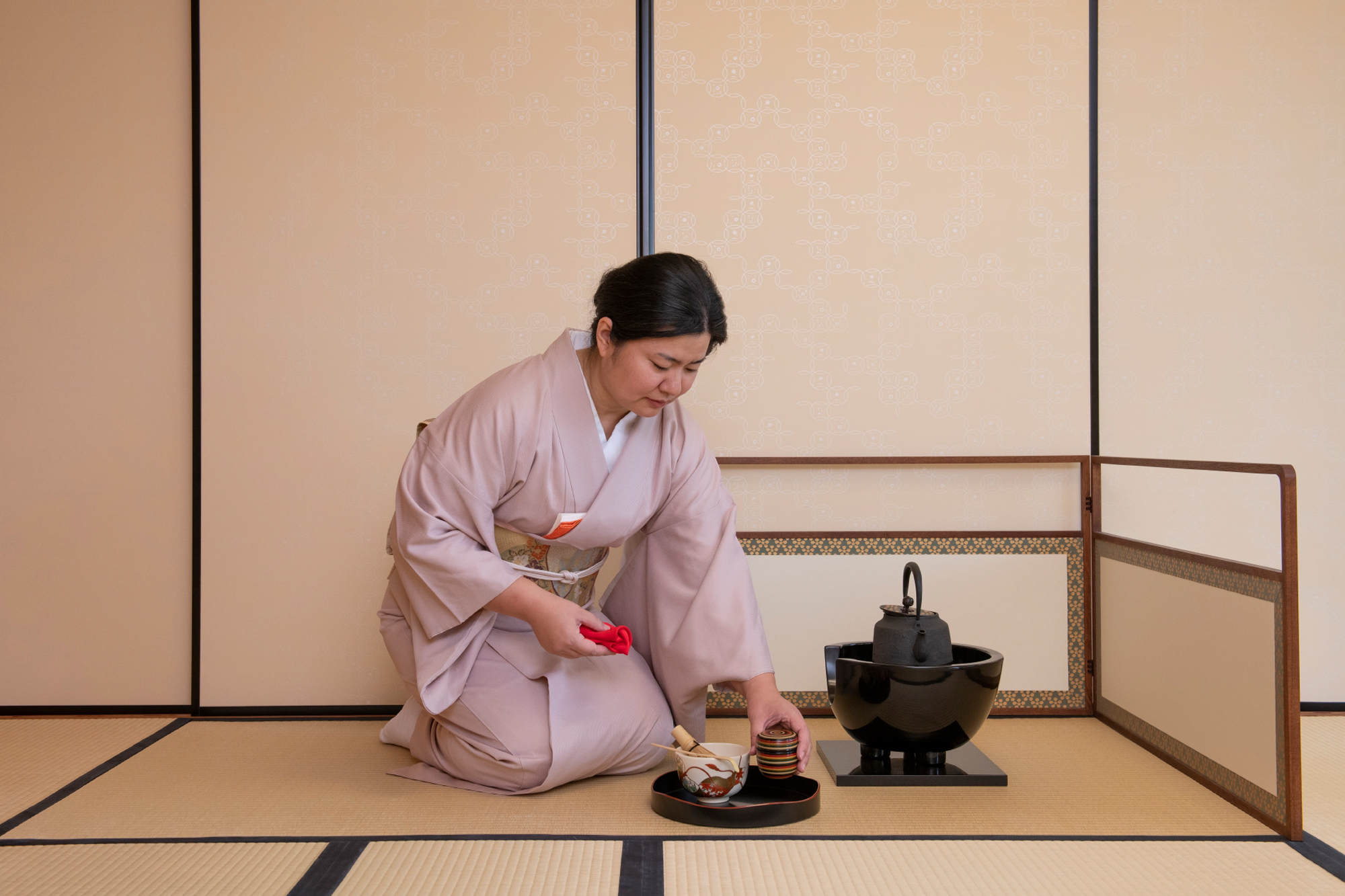
With the last chime, the dirt of everyday life is symbolically left behind. Seven pairs of shoes stand neatly on a wooden grate, just as instructed by the master Christoph Meier. If we were in Japan, the invitation to the tea ceremony would be personal, in a small circle and very exclusive. There would be a kimono and white socks, fans, napkins, cloths and a small knife to cut the sweets.

Here, in the dark park of the Museum Rietberg in Zurich, the ritual is open to all, in small groups, but no less impressive. The last leaves are hanging in the mighty trees, in the maple, sweet cherry and the magnolias, where thick tubers are already waiting for the next spring. Inside, in the attic of the museum, the Japanese tea room "Isshin-an" awaits us, where tea ceremonies have been held regularly for over twenty years. The elements for the little house in the house were handmade in Japan and assembled according to ancient knowledge by craftsmen who travelled here especially for this purpose.

It smells a bit like the straw from which the tatami mats are woven, on which people traditionally sit on their heels. An activity that will turn out to be the most challenging in the course of the ceremony. The sliding doors jerk slightly as Master of Ceremonies Meier pulls them shut, it is dim in the room, somewhere the tea kettle is roaring and sounds a little like wind brushing through pine trees. An expectant silence spreads through the room, only occasionally does someone change their sitting position from cross-legged to heels and back.

Simplicity has a special place in Japan. And one could say it emerges in its most beautiful form in the perfection displayed in the preparation of tea during a ceremony. Guided by the thought that the host and guests may only meet this one time. All the more important is the choreography of the ritual, which may last an hour or more. More food can be served, or just some sweets. But of course it is first and foremost about tea. This is prepared according to a strict recipe, whereby the temperature is crucial.

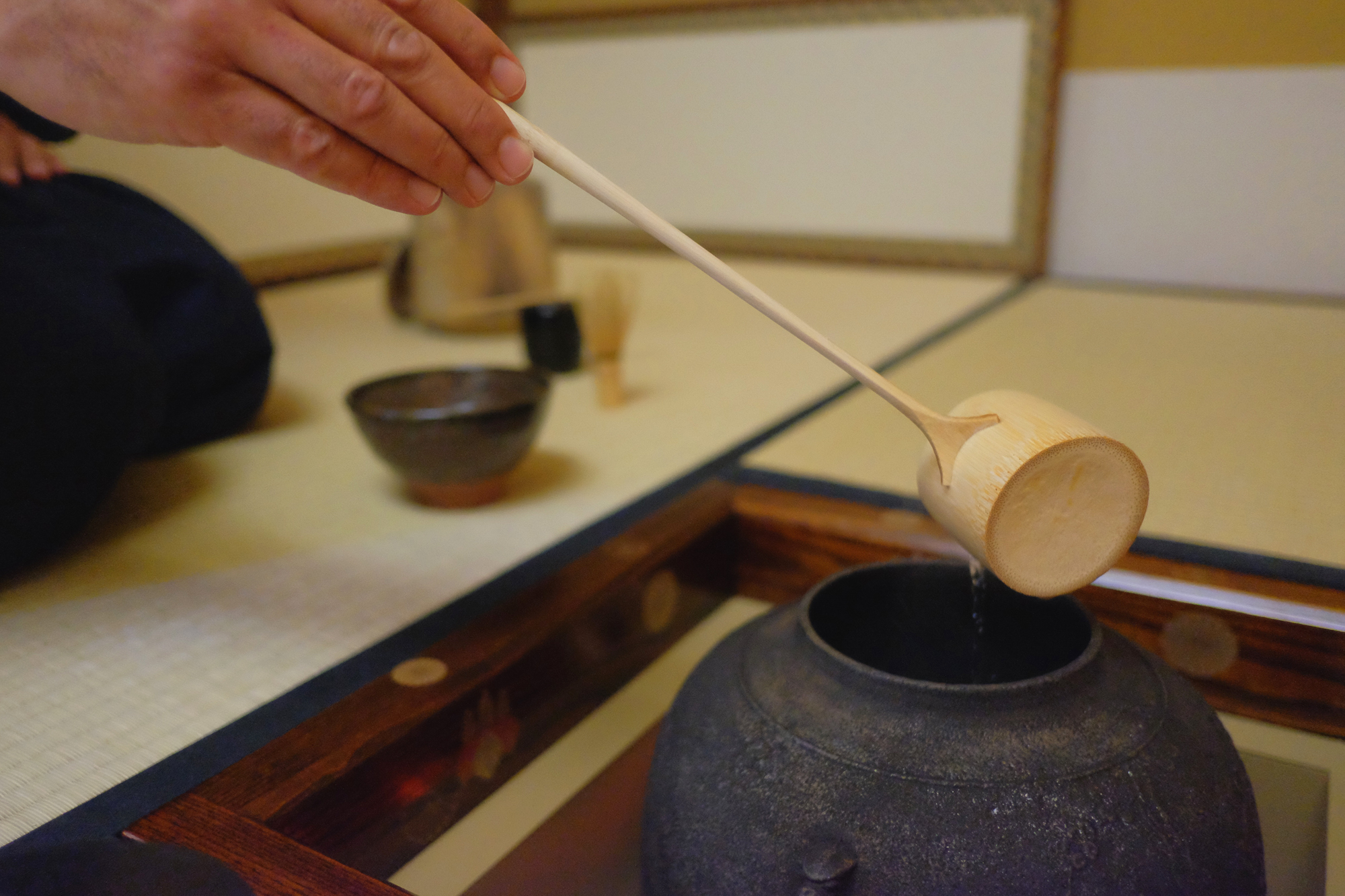
With precise movements, the master of ceremonies uses a bamboo ladle to scoop hot water out of the rushing kettle, which is hidden in the floor. He then pours it into a bowl of grated green tea, also known as matcha, before whisking it all together with a small hand whisk.

What follows is repeated six more times in exactly the same sequence over the next hour. "Please be the first to enjoy a sweet," says the tea master after he has handed over the bowl of tea, followed by a small tray. "Wagashi", as the sweet accompaniment to the tea is also called, balances out the bitter elements of the green tea and was specially made in Tokyo in a traditional manufactory. Again and again they both bow, and when asked if the bow is done properly, the tea master laughs: "If it comes from the heart, that's enough."

My feet tingle while the first guest crunches on the sweet and I calculate how long it would take until all seven had had their turn. But as time goes by, the tea master's steady, almost meditative movements blur these thoughts. Calmness spreads, suspended in the solid predictability of the repetitions, which wrap around you like the walls of the teahouse.

At some point, the master of ceremonies hands me a black tablet. On a little paper, the square sweet looks almost glassy. A fine glass of apricot with gold flakes shimmers almost amber in the semi-darkness. Silently, I bow my head and taste, having previously reimagined each guest. The foam crackles on the tea and the sweetness as I bite into it, I chew slowly and deliberately. The taste of crystal-sugared mandarins spreads, of blossoms and bergamot and completes itself in the finish with the foamy green tea.

Was dann folgt, wird sich in der kommenden Stunde noch sechs Mal in exakt gleichem Ablauf wiederholen. «Bitte geniessen sie als erster Gast eine Süssigkeit», sagt der Teemeister, nachdem er die Schale mit Tee gereicht hat und lässt ein kleines Tablet folgen. «Wagashi», wie die süsse Beilage zum Tee auch genannt wird, gleicht die bitteren Elemente des Grüntees aus und wurde eigens in Tokyo in einer traditionellen Manufaktur gefertigt. Immer wieder verneigen sich beide. Auf die Frage, ob die Verbeugung richtig gemacht werde, lacht der Teemeister: «Wenn es von Herzen kommt, dann reicht das schon.» 

Die Füsse kribbeln, während der erste Gast an der Süssigkeit knuspert und ich ausrechne, wie lange es wohl dauern würde, bis alle sieben dran waren. Doch mit der Zeit verwischen die gleichmässigen, beinahe meditativen Bewegungen des Teemeisters diese Gedanken. Ruhe breitet sich aus, aufgehoben in der festen Vorhersehbarkeit der Wiederholungen, die sich um einen legen, wie die Wände des Teehauses. 

Irgendwann reicht der Zeremonienmeister auch mir ein schwarzes Tablet. Auf einem Papierchen sieht die viereckige Süssigkeit beinahe glasig aus. Feines Glas zum Essen aus Apricot mit Goldflittern, das im Halbdunkel fast bernsteinfarben schimmert. Schweigend verneige ich mich und koste. Auf dem Tee knistert der Schaum und die Süssigkeit beim Reinbeissen. Ich kaue langsam und bedächtig. Der Geschmack von kristallzuckrigen Mandarinen breitet sich aus, von Blüten und Bergamotte und vervollständigt sich im Abgang mit dem schaumigen Grüntee. 

Öffentliche Teezeremonien finden in regelmässigen Abständen statt. Bei der After-Work-Teezeremonie klingt der Arbeitstag bei herzhaften Amuse-Bouches in Ruhe aus.  

© Museum Rietberg

Museum Rietberg Zurich

Japanische Teezeremonie

Die japanische Teezeremonie lädt dazu ein, einen Moment der Stille und die Ästhetik der Reduktion zu geniessen. Tief in der japanischen Kunstgeschichte ...

Totoya Hokkei (1780–1850), Es ist gut, einen neuen Brunnen auszuheben, aus der Serie «Eine Serie für den Hanazono-Zirkel», Edo-Zeit, um 1824 © Museum Rietberg

Museum Rietberg Zurich

Japan de luxe

With the exhibition Japan de luxe, Museum Rietberg showcases surimono, a distinctive form of Japanese colour woodblock print that emerged between the late ...

until 12.07.2026

Porträt von Dschingis Khan, Sh. Sainzul, 2022, Chinggis Khaan National Museum

Museum Rietberg Zurich

Mongolia

A Journey through Time.

until 22.02.2026

Urheber unbekannt, Shiva tanzt zu Ehren der Göttin, Indien, Rajasthan, Udaipur, um 1730, Museum Rietberg, Inv.-Nr. RVI 975, Ankauf mit Mitteln von Eberhard und Barbara Fischer

Museum Rietberg Zurich

Colour

Art in the Park-Villa.

until 10.05.2026

Published from Seraina Kobler on December 15, 2022.

More from our scouts

Urban dance floor(s)
01.05.2025

Urban dance floor(s)

Von Gesellschaftsnormen, Tanzfreuden und Einhörnern: Fünf Veranstaltungen, die du am Festival ZÜRICH TANZT besuchen solltest.

Sari Pamer
Sari Pamer
A lot of fuss about a small twirl
13.03.2025

A lot of fuss about a small twirl

Nur ein Gschichtli, aber ein gutes: Jungkritiker Gustavo und sein Papa verbringen den Sonntagmorgen bei Frau Holle und ihrem fidelen Gehülfen.

Adrian Schräder
Adrian Schräder
Artothek: Steel plates of consolation
04.04.2024

Artothek: Steel plates of consolation

In the "Artothek", the authors of the culture magazine Coucou tell the individual creative stories of works of art from Winterthur. This time: at the entrance to Rosenberg cemetery.

Coucou Kulturmagazin

More from your scouts

Eleonora Bitterli
Eleonora Bitterli
Gretta Bott
Gretta Bott
Rebekka & Sebastian
Rebekka & Sebastian
Katharina Nill
Katharina Nill
Nadja Heinsius
Nadja Heinsius
Phil Hayes
Phil Hayes
All scouts